Copyright© GIZ

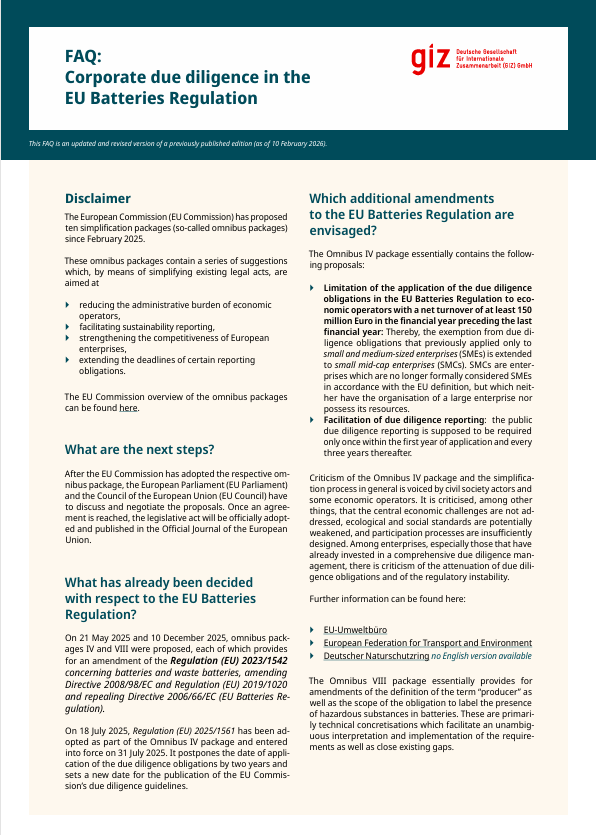
New publication: FAQ regarding the corporate due diligence in the EU Batteries Regulation
On 18 July 2025, the Council of the European Union adopted the Regulation (EU) 2025/1561 amending the Regulation (EU) 2023/1542 on batteries and waste batteries. This postpones the start of corporate due diligence obligations for economic operators under the EU Batteries Regulation by two years, from 18 August 2025 to 18 August 2027. At the same time, the deadline for the European Commission to publish corresponding guidelines has also been extended to 26 July 2026. The deadline was previously set for 18 February 2025.
The new regulation is part of the EU’s so-called Omnibus IV package, which aims to simplify existing rules and strengthen the competitiveness of European industry. The EU Commission has proposed ten Omnibus packages since February 2025. In addition, both the Omnibus IV and Omnibus VIII packages include further proposals to amend the EU Batteries Regulation.
While the Omnibus IV Package includes proposals related to the application and reporting of due diligence, the Omnibus VIII package contains complementary amendments that focus in particular on technical aspects of the EU Batteries Regulation. These include changes to the definition of the term “producer” as well as to the scope of the obligation to label the presence of hazardous substances in batteries. These amendments aim to support a clearer interpretation and implementation of the EU Batteries Regulation and to address existing gaps.
The EU Batteries Regulation
The Regulation (EU) 2023/1542 concerning batteries and waste batteries, amending the Directive 2008/98/EC and the Regulation (EU) 2019/1020 and repealing the Directive 2006/66/EC (EU Batteries Regulation), which was adopted in 2023, is the first supply chain regulation that considers the entire supply chain and the complete life cycle of a battery - from mine to recycling. The EU Batteries Regulation repeals the EU Batteries Directive (206/66/EC), which focused primarily on the disposal and recycling of batteries.
The key objectives of the EU Batteries Regulation include strengthening the EU internal market, reducing environmental and social risks at all stages of the battery life cycle and promoting a circular economy. To achieve these objectives, the EU Batteries Regulation includes corporate due diligence obligations for the supply chains of the minerals required for batteries. These include cobalt, natural graphite, lithium and nickel, as well as their chemical compounds.
Relevant content of the EU Batteries Regulation regarding development policy
From August 2027, large economic operators offering batteries on the market or putting them into service in the EU, as well as public procurers, must comply with the human rights and environmental due diligence obligations set out in the EU Batteries Regulation for their entire battery supply chains. The due diligence obligations set out in the EU Batteries Regulation include the creation and publication of a strategy for raw materials used in batteries, the establishment of a system of controls and transparency, and the introduction of a complaints mechanism as an early warning system for risk detection amongst others.
The postponement of the application gives companies more time to prepare and implement these requirements.
Copyright© GIZ

At the same time, ongoing EU legislative processes may lead to changes in the scope of due diligence obligations. The Omnibus IV and Omnibus VIII packages already propose several changes, including limiting due diligence obligations to economic operators with a net turnover of at least 150 million Euro in the financial year and reducing reporting requirements.
Find out more about the corporate due diligence obligations set out in the EU Batteries Regulation in our FAQ (External link).
In case of questions about the development policy aspects of the corporate due diligence obligations to the EU Batteries Regulation, please contact rohstoffe@giz.de.
We ask for your understanding that we cannot answer any further questions about the EU Batteries Regulation.