Copyright© GIZ

International Day of Human Rights “Human Rights-Responsible Raw Materials Extraction” - A Discussion with the European Partnership for Responsible Minerals (EPRM)
Interviewer: What is the EPRM and what are the main topics and instruments on which you focus your work?
EPRM: The EPRM is a multi-stakeholder initiative. We work with partners from different interest groups. Members include European Governments, such as Germany through BMZ, the Netherlands, France, and Great Britain as well as the EU, the OECD and the World Bank as observers. In addition, there are companies along the entire supply chain and many civil society voices and partners.
EPRM was established almost 10 years ago as a accompanying measure for EU-level legislation on conflict minerals with a focus on gold and the 3T (tin, tungsten, and tantalum) in conflict regions. However, we now work on critical raw materials with a focus on human rights and environmental due diligence in high-risk regions. It is no longer only about gold and the 3T, but rather about all minerals that are mined in artisanal and small-scale mining (ASM).
We work with different instruments and on different topics. It is very important for us that we implement projects locally. In recent years, we have done this largely on a trial basis on various topics: for example, on transparency, gender equality, occupational health and safety measures or standard development.
Complementary to the projects, we focus strongly on knowledge exchange and dialogue. This is what makes EPRM unique: different stakeholders from different groups along the supply chain come together in an initiative to talk about difficult topics and find solutions in a protected space.
We develop knowledge products and tools and try to incorporate these in additional discussions, in production countries but also with the EU and in discussions about critical raw materials strategies to ensure that small-scale mining is integrated.
Copyright© GIZ

Interviewer: Do you have partners with whom you collaborate in the countries?
EPRM: The projects are set up in a way that we as EPRM cannot implement them alone but rather finance the projects. Each project has a coalition of project partners. These can be our members, but it is open to anyone who wants to implement a project.
The project coalitions must have a multi-stakeholder character. NGOs based in the countries themselves are involved. The same is true for economic partners, such as companies, that ideally can also establish formal market access or are involved in the solution.
Interviewer: What makes the raw materials sector especially vulnerable to human rights risks along the supply chain?
EPRM: Compared to other supply chains, raw material supply chains are very complex and fragmented. A raw material supply chain has many stages and intermediaries and is, therefore, difficult to control. Raw materials are primarily mined in regions where there are fewer strong governance structures. Additionally, raw materials are often extracted in conflict contexts and can simultaneously be the subject of wars and conflicts.
When we look at the artisanal and small-scale mining (ASM) sector, it is important to consider the difference to industrial mining. The ASM-sector is very informal and, as a result, also weakly regulated. That creates challenges to implement safety standards. In the ASM-sector, people work in mines without proper protective equipment. In small and artisanal gold mines, for example, mercury is often used, which is harmful to health and the environment. There are many human rights dimensions, especially with regards to gender: women do not have access to licenses in raw material extraction, land rights, or finances, e.g. loans. At the same time, they are paid less.
As EPRM, it is important for us to integrate these risks and not to withdraw from them. The work in the ASM-sector is important for the supply security of raw materials, but also for its development policy components. According to estimates, 45 million people work directly in the ASM-sector and about 315 million people earn their livelihoods indirectly from it. Employment is a key to move away from poverty, so the sector is very important.
Interviewer: How can the situation be improved, especially in the ASM sector? What mechanisms are in place to mitigate human rights risks?
EPRM: The most important thing is to turn the image of ASM around. That is why we work on narrative building. Because it is a fallacy that ASM is a risk in its own supply chain or that it ideally should not be included in the supply chain at all.
Our approach is to show that ASM is not necessarily in itself problematic for human rights. ASM exists in many countries where there are human rights problems, but it is also possible to extract minerals or raw materials in small-scale mining so that human rights standards, gender equality, occupational safety and the rights of indigenous peoples are better protected. To get there, as a company or government one must show engagement and not try to hide the problem away. For us, it is crucial that this occurs in dialogue and in collaboration with local stakeholders.
In recent years, the narrative has developed strongly in favor of critical raw materials and supply security. The focus is primarily on large-scale mining and less on the role of small-scale mining. It is important to talk about how small-scale mining can be managed responsibly and how job development opportunities such as income and jobs will not be jeopardized or criminalized. The focus should be on how small-scale mining can be integrated into global supply chains in a responsible way.
This is very much about formal market access, access to financing, thinking about the entire supply chain, and promoting collaboration across the chain. We pursue this approach in EPRM and see our role as carrying out coordinated interventions in partnership with the entire network. These changes bring improvements.
Copyright© Cobalt for Development

Interviewer: What can this look like in concrete terms? Can you give an example of a project that shows how your work improves the human rights conditions on the ground?
EPRM: One project that we are currently implementing in the DR Congo is the “Cobalt Credits”. The project is being implemented by the Impact Facility, Fairphone and other partners. The Cobalt Credits is a book and claim system. This means that if you have a metric tonne of Cobalt that is produced in a certain small-scale mine and meets minimum standards, a credit is issued. Companies at the end of the supply chain, e.g. manufacturers of EV batteries, can buy these credits, regardless of whether this cobalt is physically used in the supply chain. The proceeds from the sale of the credits then flow into a “Mine Improvement Fund”. This in turn is used to finance measures that will improve the local situation, including job safety and better governance structures, but also environmental protection and economic development for local mining communities.
Everything is organised by a local Fund Allocation Committee, which consists of representatives of mine workers and project partners. They decide on the use of the funds in a transparent process. That way they can make decisions, such as the improvement of job safety, fair pay or better environmental standards. The goal is to make ASM for cobalt easier to plan and to ensure responsible mining.
The fund can be used to ensure that local living and working conditions are improved. The plan is to scale up this process in the long term.
Interviewer: Which projects and thematic priorities are planned for 2026?
EPRM: There are many plans for 2026. Next year we will celebrate 10 years of EPRM and want to analyse which projects and interventions have led to good outcomes and what we could develop further. Our aim is to bring the network and ecosystem, as well as all the people that work on ASM, closer together. Narrative and strategy building for the ASM sector beyond EPRM is key for us so that we can scale up promising approaches in partnership with other stakeholders.
Next year, we want to start implementing two new projects based on initial positive results. We are also preparing the tender for a new lithium project in Zimbabwe.
We are working on an ASM Engagement Framework for downstream stakeholders, e.g. automotive companies who want to know how to deal with ASM in the supply chain in a constructive way. We are developing specific guidelines for this. And we are working on a policy briefing on how to finance ASM interventions.
Germany has been a member of the European Partnership for Responsible Minerals (EPRM) since January 2020, represented by the Federal Ministry for Economic Cooperation and Development (BMZ). The Sector Programme Extractives and Development has been supporting the EPRM on behalf of the BMZ since 2016. Since mid-2025, an advisor seconded by the GIZ Sector Programme has been supporting the EPRM Secretariat.
Related information:
More about EPRM:
- EPRM White Paper: “Fostering Responsible ASM for Reliable Mineral Supply Chains” (External link)
- Cobalt Credits projectvideo: New EPRM Video: Why engagement with ASM matters (External link)
- Project-Website: Developing a replicable and scalable MC system for application in ASM CCs in DR Congo (External link)
- OECD Due Diligence Guidance for Responsible Supply Chains of Minerals from Conflict-Affected and High-Risk Areas (External link)
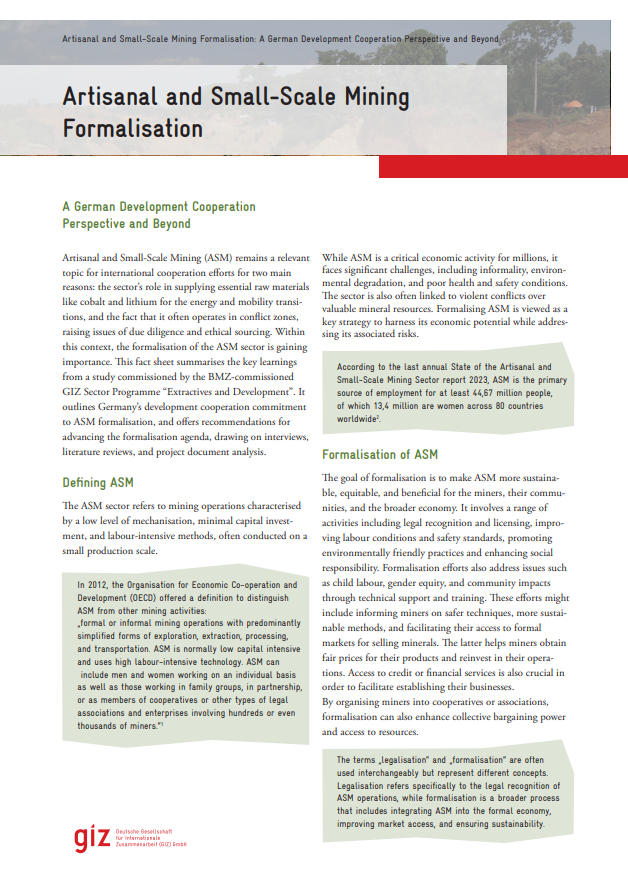
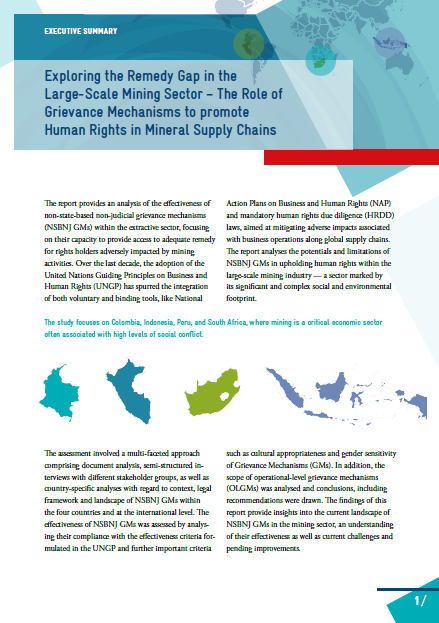
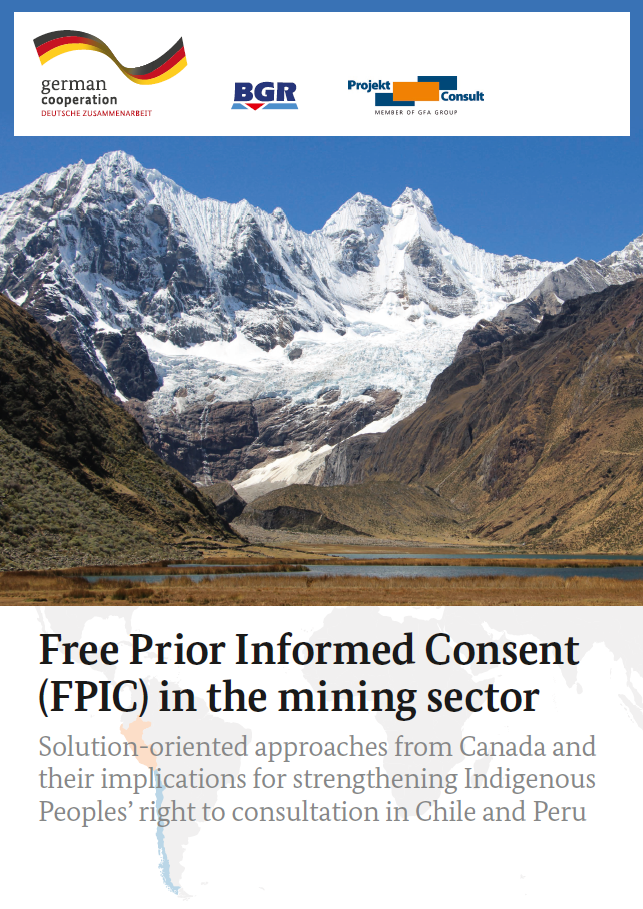
Publications related to human rights in the mining sector: