Copyright© GIZ

EITI Membership: Promoting Investment and Combating Corruption
Corruption and a lack of transparency hold back investment in resource-producing countries. Yet an attractive investment climate is essential for the economic development of partner countries and strategically important for developing resilient raw material supply chains to Germany and Europe.
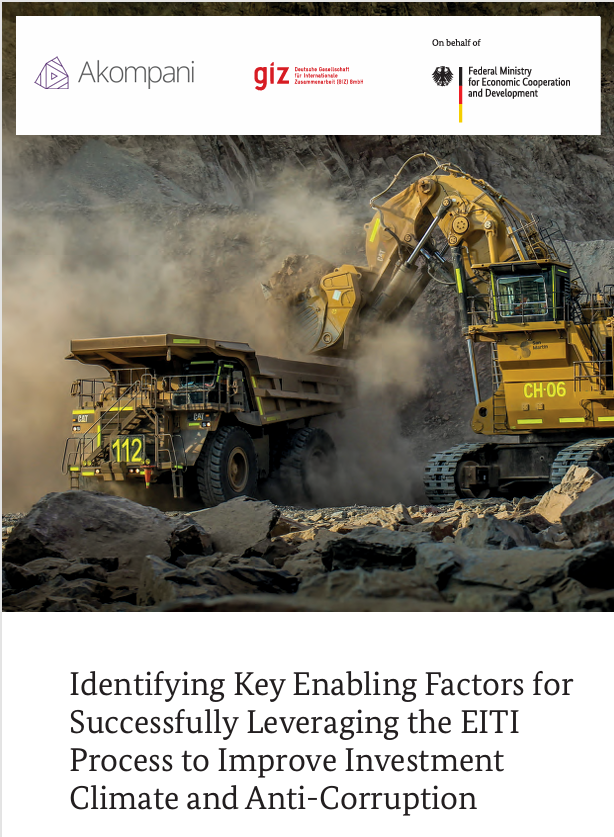
A new study by GIZ Sector Programme “Extractives and Development” “Identifying Key Enabling Factors for
Successfully Leveraging the EITI Process to Improve Investment Climate and Anti-Corruption” examines the extent to which implementing the Extractive Industries Transparency Initiative (EITI) Standard can improve the investment climate through anti-corruption efforts, as well as which additional factors are important to achieving these goals. Commissioned by the German Federal Ministry for Economic Cooperation and Development (BMZ), the study was conducted by Akompani Ltd.
The authors combined a quantitative analysis of governance, corruption perception and investment indicators during EITI membership with qualitative research, stakeholder interviews and document analysis. This enabled them to identify patterns and success factors. Based on their findings, the study provides recommendations for governments, the EITI International Secretariat, donors, civil society, companies and international financial institutions. Their shared goal is to make the EITI process more effective in improving the investment climate and combating corruption.
EITI Membership Is Associated with Higher Foreign Direct Investment
The study finds that EITI membership is more frequently associated with an increase in foreign direct investment (FDI), particularly in countries of the Global South. Several country cases demonstrate a statistically significant association between EITI implementation and FDI. In addition, EITI membership sends a positive signal of stability and openness to transparency.
This is particularly evident in the Democratic Republic of the Congo (DRC), Guyana, Timor-Leste and Nigeria, where FDI growth can be clearly linked to EITI implementation. However, for implementation of the Standard to have a tangible impact, membership alone is not enough. Comprehensive institutional and regulatory reforms, alongside stronger sectoral oversight, are essential.
EITI Can Combat Corruption – If Implemented Consistently
The study also identifies measurable progress in combating corruption. Senegal, Zambia, Guyana and Nigeria stand out: in these countries, EITI implementation is statistically significantly associated with lower perceived levels of corruption, as measured by the Corruption Perceptions Index (CPI). Published by Transparency International, the CPI measures perceived levels of public-sector corruption based on assessments by experts and businesspeople. Countries are scored on a scale from 0 (perceived as highly corrupt) to 100 (perceived as full of integrity).
This positive effect is reinforced above all by consistent implementation and follow-up. Countries such as Senegal and Zambia, which have implemented the EITI Standard particularly rigorously, recorded the greatest progress. The conclusion is clear: formal membership alone is not enough. What matters is the credible and effective implementation of EITI recommendations.
Copyright© GIZ

The study was presented during the 2027 EITI Global Conference in Brussels
Seven Success Factors for Improving the Investment Climate and Combating Corruption
Case studies from the Democratic Republic of the Congo and Zambia identify seven factors that determine whether EITI membership leads to measurable progress in improving the investment climate (IC) and combating corruption (AC):
1. Strong political commitment across electoral cycles. Sustained high-level support, for example, from finance and mining ministries or state-owned enterprises, creates greater predictability for investors and strengthens the capacity of enforcement authorities to address irregularities.
2. Systematic transparency in contracts and licences. Disclosure of fiscal frameworks, licence awards and cadastral data reduces perceptions of arbitrariness, improves investors’ risk assessments and helps curb corruption.
3. Institutional follow-up on EITI findings. Transparency without enforcement has limited impact. Consistent follow-up on recommended corrective measures is what turns transparency into an effective tool for combating corruption.
4. High-level representation in multi-stakeholder groups. When ministers or heads of state-owned enterprises participate in multi-stakeholder groups (MSGs), recommendations are more likely to be implemented. This accelerates reforms and strengthens trust among investors and civil society.
5. Inclusion of artisanal and small-scale mining (ASM). Integrating ASM into EITI reporting makes supply chains more predictable and attractive to responsible buyers, while reducing their vulnerability to illegal trade.
6. Regional transparency frameworks. Cross-border disclosure can curb smuggling, strengthen market confidence and address regional corruption risks – particularly for high-risk commodities such as gold.
7. Positive signalling to investors. Even where quantitative findings were mixed, interviews showed that EITI membership signals fiscal transparency and regulatory stability, thereby influencing investment decisions beyond what the figures alone can capture.
The full study provides all findings and recommendations for stakeholders.